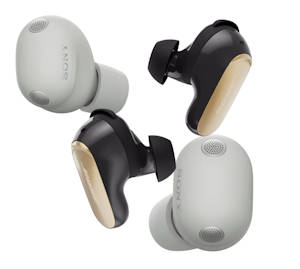
If the AirPods Pro are the lifestyle choice, the battle between Sony and Bose is the heavyweight title fight for pure engineering dominance.
For years, the narrative was simple: Bose had the best Active Noise Cancellation (ANC), and Sony had the best sound quality. With the release of the Bose QuietComfort Ultra Earbuds Gen 2 in June 2025, Bose narrowed the sound quality gap significantly. Now, with the Sony WF-1000XM6, Sony is attempting to steal the ANC crown.
This Sony WF-1000XM6 vs. Bose QC Ultra Gen 2 comparison is not about features or apps; it is about the decibel reduction curve. We are looking at who creates the purest void.
1. The ANC Architecture: CustomTune vs. QN3e (Sony WF-1000XM6 vs. Bose QC Ultra Earbuds Gen 2)
The approach to silence is fundamentally different between Framingham (Bose) and Tokyo (Sony). Here is the comparison of the approaches for Sony WF-1000XM6 vs. Bose QC Ultra Earbuds Gen 2.
Bose QC Ultra Earbuds Gen 2: The “Vacuum” Effect
The Bose QC Ultra Gen 2 utilizes an aggressive proprietary algorithm called CustomTune.
- The Chime: When you insert the buds, that sweeping tone isn't just a startup sound; it's a sonar ping. The mic measures the acoustic response of your specific ear canal and calibrates the anti-noise filter instantly.
- The Result: Bose achieves a terrifyingly high level of attenuation in the sub-bass frequencies (20~200Hz). It creates a physical sensation of pressure—a “vacuum” effect—that completely erases the drone of an airplane engine. It is effective, but for some users, it can be nauseating (the “eardrum suck” phenomenon).
Sony WF-1000XM6: The Natural Void
The Sony WF-1000XM6 relies on the sheer processing power of the QN3e chip and the new 8-microphone array.
- The Strategy: Rather than a brute-force vacuum, Sony targets specific frequencies with higher precision. The new 32-bit processor allows for more complex notch filters in the mid-range.
- The Result: Sony’s silence feels “lighter.” You don't feel the pressure change as intensely. While Bose might reduce a jet engine by 45 dB, Sony might hit 43dB —technically less, but practically indistinguishable.
The Edge:
- Deep Rumble (Planes/Trains): Bose wins. The floor drops out completely.
- Mid-Range (Voices/Office): Sony wins. The extra feedback microphones in the XM6 handle erratic human speech better than Bose’s algorithm, which prefers constant drones.