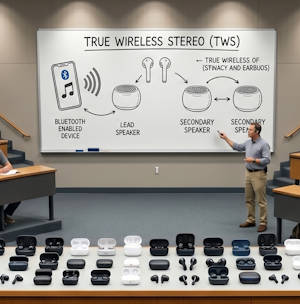
When you pull a pair of flagship earbuds out of their charging case, insert them into your ears, and press play, the immediate synchronization of stereo audio feels like magic. However, behind that seamless user experience lies one of the most notoriously difficult radio frequency (RF) engineering challenges of the 21st century: True Wireless Stereo (TWS).
For years, “TWS” was largely a marketing buzzword rather than a standardized protocol. If you are searching for True Wireless Stereo explained at an engineering level, you must understand that the human body is inherently hostile to wireless data transmission.
To definitively answer what TWS technology is, we have to look past the spec sheet. In this technical deep-dive, we will explore everything about True Wireless Stereo (TWS): the physics of the “Head-Shadow” effect, the dark ages of proprietary Bluetooth sniffing, the mathematical reality of phase distortion, and how the industry finally standardized the hardware to solve the problems that have plagued wireless audio for a decade.
The Physics of the Enemy of TWS: The Head-Shadow Effect
To understand how wireless earbuds work—and more importantly, why they frequently fail—we must start with the physics of the 2.4 GHz Industrial, Scientific, and Medical (ISM) radio band used by Bluetooth.
Radio waves are a form of electromagnetic radiation. How they interact with physical obstacles depends entirely on their wavelength (\lambda). We can calculate the wavelength of a Bluetooth signal using the speed of light (c) and its frequency (f):
\lambda = \frac{c}{f} = \frac{3 \times 10^8\text{ m/s}}{2.4 \times 10^9\text{ Hz}} \approx 12.5\text{ cm}A wavelength of 12.5cm (~4.9 inches) presents a massive physiological problem: it is roughly the width of an adult human skull.
When a wavelength is roughly the same size as an obstacle, the wave does not easily diffract (bend) around it. Furthermore, the human head is primarily composed of water and dense tissue, both of which are exceptionally efficient absorbers of 2.4 GHz microwave radiation.
This creates the head-shadow effect that Bluetooth engineers constantly battle. In the early days of wireless audio, sending a signal from your right pocket to your left earbud meant the radio wave had to penetrate human tissue, resulting in massive signal attenuation (signal loss) of up to 20dB to 30dB. This physical barrier is the primary reason early wireless earbuds suffered from constant dropouts and desynchronization.


The Dark Ages: Master-Slave Routing and Proprietary Sniffing for True Wireless Stereo (TWS)
Classic Bluetooth (BR/EDR) and its Advanced Audio Distribution Profile (A2DP) were strictly designed for a point-to-point connection—one smartphone streaming to one endpoint. A2DP simply did not understand how to stream to two independent earbuds.
Because there was no unified TWS standard, manufacturers had to invent proprietary “hacks” to bypass the protocol. This resulted in two distinct architectural eras:
Era 1: Cross-Head Bluetooth Transmission (The Master/Slave Hack)
In first-generation TWS earbuds, the smartphone would establish a standard A2DP connection to the “Primary” earbud (the Master, for example, the left earbud). The Primary earbud received the full 328 kbps SBC stereo stream, processed it, stripped out the left channel for its own speaker, and then acted as a transmitter to beam the right channel through the user's skull to the “Secondary” earbud (the Slave).
Because of the head-shadow effect, the Primary earbud had to broadcast at maximum RF gain. This resulted in terrible battery life for the Primary earbud (which would frequently die an hour before the Secondary earbud) and introduced severe latency, often pushing audio delay ( t_{delay}) well past 300 ms.
Era 2: TrueWireless Mirroring and Eavesdropping
To solve the battery drain and latency of cross-head transmission, silicon manufacturers like Qualcomm and Apple (with the W1 chip) developed proprietary “eavesdropping” protocols.
In this topology, the smartphone still officially connects to the Primary earbud. However, the Secondary earbud covertly monitors the exact Bluetooth MAC address and Link (pairing) Key of the primary connection. It sits in the RF environment and “sniffs” the packets being sent from the phone to the Primary earbud, selectively decoding only its respective audio channel.
While incredibly efficient, these hacks were proprietary; a Qualcomm TWS implementation could not seamlessly hand off audio if the user switched from an Android phone to an iPhone.
Hardware Constraints: Antennas and Silicon Bottlenecks
If you are researching why wireless earbuds disconnect when you walk through a crowded intersection or airport, the answer rarely lies in the software protocol. It is almost always a hardware limitation.
Antenna Engineering: Ceramic vs. LDS
Budget TWS earbuds frequently use ceramic chip antennas or trace antennas printed flat on the internal PCB. Because physical space is at a premium, these antennas are often crammed next to the lithium-ion battery or the dynamic driver's neodymium magnet, resulting in severe electromagnetic interference (EMI) and terrible radio gain.
Premium flagship earbuds utilize Laser Direct Structuring (LDS). Engineers use a multi-axis laser to etch the antenna array directly onto the inside curvature of the earbud's plastic outer shell. This pushes the antenna as far away from the internal electronics—and the user's skin—as physically possible, maximizing the RF line-of-sight to the smartphone and drastically reducing dropped packets.
SoC Computational Ceilings
Running a modern TWS system is computationally brutal. The onboard System-on-a-Chip (SoC) must simultaneously maintain the Bluetooth radio link, decode high-res audio (like LDAC or Samsung Seamless Codec) via Fast Fourier Transforms, run the Adaptive ANC algorithm (inverting phase thousands of times a second), and execute machine learning voice-isolation models.
When a budget earbud SoC hits its thermal or computational ceiling, it must prioritize tasks. It usually drops the Bluetooth radio transmission power or downgrades the audio bitrate to prevent a crash, leading to sudden, inexplicable audio degradation.
Phase Distortion and Clock Drift in True Wireless Stereo (TWS)
In a wired stereo system, the left and right speakers receive the analog electrical signal at the exact same time. In a TWS system, the left and right earbuds receive their digital packets independently. They must execute the digital-to-analog conversion at the exact same microsecond to maintain a coherent stereo image.
This relies on the internal crystal oscillators (the hardware clocks) inside each earbud. However, crystal oscillators are imperfect. They suffer from a tolerance variance measured in parts per million (ppm).
If an earbud's oscillator has a tolerance of \pm 20\text{ ppm}, we can calculate the temporal drift per second:
\Delta t = 20 \times 10^{-6} \text{ seconds/second} = 20 \mu \text{ second/second}At a standard CD-quality sample rate of 44.1 kHz, one audio sample is approximately $22.6\mu \text{ s} long. This means a 20 ppm drift will cause the earbuds to lose or gain a full sample every single second.
When the left and right earbuds drift out of sync, the audio phases shift. To fix this, the earbud's DSP utilizes Asynchronous Sample Rate Converters (ASRC) to artificially speed up or slow down the audio buffer on one side, forcing them back into alignment. In lower-tier TWS earbuds, this constant resampling introduces micro-stutters, jitter, and destroys the “center image” of the audio mix, making vocals sound smeared or slightly hollow.
![Samsung Galaxy Buds 4 (2026) AI True Wireless Bluetooth Earbuds + $20 Gift Card, Noise Cancelling, Hi-Res Audio, 1-Way Speaker, New Fit, IP54, Live Translation, Black [US Version, 2 Yr Warranty]](https://m.media-amazon.com/images/I/31lBrdEkiML._SL160_.jpg)

The Solution: Bluetooth LE Audio Multi-Stream
The era of proprietary sniffing and TWS instability has finally come to a close with the advent of Bluetooth 5.2. If you are comparing TWS vs Bluetooth standards today, the conversation is entirely focused on the integration of Bluetooth LE Audio Multi-Stream.
As covered in our LE Audio deep-dive (coming soon), the Bluetooth Special Interest Group (SIG) officially standardized True Wireless Stereo (TWS) functionality by introducing Connected Isochronous Streams (CIS).
For the first time, the Bluetooth protocol allows a source device (your smartphone) to natively generate two separate, parallel Isochronous channels. It transmits the left channel exclusively to the left earbud, and the right channel exclusively to the right earbud. Because both channels share a standardized CIG (Connected Isochronous Group) timing reference, the audio playback is perfectly aligned down to the microsecond. The head-shadow effect is bypassed entirely, battery drain is equalized, and the connection stability in crowded RF environments skyrockets.
True Wireless Stereo: A Masterclass in Miniaturization
True Wireless Stereo is no longer a marketing gimmick; it is an incredibly robust, standardized RF architecture. What began as a series of desperate engineering hacks to force a 1990s wireless protocol to stream synchronized stereo audio has evolved into the sophisticated LE Audio infrastructure we use today.
The next time you place those earbuds in your ears and the music seamlessly blooms into the center of your head, take a moment to appreciate the staggering amount of physics, cryptography, and real-time mathematical alignment happening in the background.
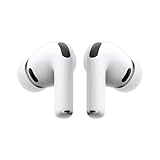
- WORLD’S BEST IN-EAR ACTIVE NOISE CANCELLATION — Removes up to 2x more unwanted noise than AirPods Pro 2* so you can stay fully immersed in the moment.*
- BREAKTHROUGH AUDIO PERFORMANCE — Experience breathtaking, three-dimensional audio with AirPods Pro 3. A new acoustic architecture delivers transformed bass, detailed clarity so you can hear every instrument, and stunningly vivid vocals.
- HEART RATE SENSING — Built-in heart rate sensing lets you track your heart rate and calories burned for up to 50 different workout types.* With iPhone, you will have access to the Move ring, step count, and the new Workout Buddy,* powered by Apple Intelligence.*
- LIVE TRANSLATION — Communicate across language barriers using Live Translation,* enabled by Apple Intelligence.*
- EXTENDED BATTERY LIFE — Get up to 8 hours of listening time with Active Noise Cancellation on a single charge. Or up to 10 hours in Transparency using the Hearing Aid feature.*

This article is part of our Headphone 101 series, dedicated to demystifying the complex engineering behind modern acoustic technology. Explore our other technical deep-dives to master the hardware that drives your daily audio experience.
You may check Headphone 101 for detailed explanations of headphone technologies and terms.
For Bluetooth headphone guides, please check the Bluetooth headphones section.
The sports headphones section is dedicated to guides on sports headphones.
You may also reach us through our Facebook page.


Leave a Reply