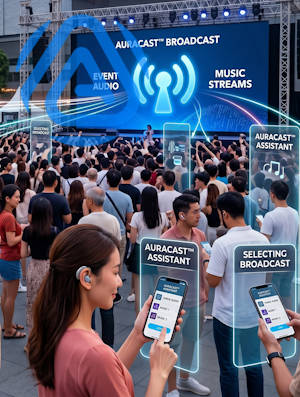
For the past twenty-five years, wireless audio has been defined by a strict, unbreakable rule: monogamy. If you paired your headphones to your smartphone, that audio stream was a closed, proprietary tunnel. Sharing what you were listening to meant physically handing an earbud to someone else or navigating frustrating, proprietary dual-audio software workarounds.
This limitation wasn't a lack of imagination; it was a fundamental constraint of radio frequency architecture. However, the introduction of Bluetooth Auracast technology represents the most radical architectural tear-down of the Bluetooth standard since its inception.
If you are a tech enthusiast wondering exactly how does Auracast work, it is crucial to understand that it is not simply a new pairing mode. It is a complete rewrite of the Bluetooth protocol stack, shifting from a connection-oriented, point-to-point topology to a connectionless, point-to-multipoint broadcast architecture.
In this Bluetooth Auracast deep dive, we will dissect the underlying physical layers, the mathematical efficiencies of the LC3 codec, the complex triad of hardware required (Broadcasters, Assistants, and Receivers), and why your legacy television cannot simply be updated to support the Bluetooth LE Audio broadcast standard.
1. The Legacy Constraint: Classic Bluetooth Architecture
To appreciate the engineering leap of Auracast, we must first examine why the “Bluetooth monogamy” rule existed in the first place.
Classic Bluetooth (BR/EDR – Basic Rate/Enhanced Data Rate) operates on a “Piconet” topology. In a Piconet, one device acts as the Master (your smartphone), and it can connect to up to seven Active Slaves (your earbuds, smartwatch, car stereo).
While a Master can theoretically connect to multiple devices, the Advanced Audio Distribution Profile (A2DP)—the protocol used for streaming high-fidelity stereo music—is strictly point-to-point. The Master device uses a Polling mechanism, rapidly switching its radio transceiver between active slaves in predefined time slots.
When analyzing Auracast vs standard Bluetooth, the mathematical limitation of classic Bluetooth becomes obvious. If a smartphone tries to send an identical 328 kbps SBC audio stream to three different pairs of headphones simultaneously, it must duplicate the packet, encrypt it three separate times with three different link keys, and transmit it three separate times during distinct time slots.
This rapidly exhausts the channel capacity defined by the Shannon-Hartley theorem:
C=B\log_2(1+S/N)
Where C is the channel capacity in bits per second, B is the bandwidth (1 MHz channels in classic Bluetooth), andS/N is the signal-to-noise ratio (SNR). The bandwidth simply cannot support brute-force packet duplication without inducing massive latency, packet loss, and severe audio dropouts.
![Samsung Galaxy Buds 4 (2026) AI True Wireless Bluetooth Earbuds + $20 Gift Card, Noise Cancelling, Hi-Res Audio, 1-Way Speaker, New Fit, IP54, Live Translation, Black [US Version, 2 Yr Warranty]](https://m.media-amazon.com/images/I/31lBrdEkiML._SL160_.jpg)

2. The Foundation: LE Audio and Isochronous Channels
The paradigm shift arrived with Bluetooth 5.2 and the introduction of Bluetooth LE (Low Energy) Audio. Prior to this, Bluetooth Low Energy was strictly for low-bandwidth IoT devices (heart rate monitors, smart home sensors). It could not handle continuous audio.
Bluetooth LE Audio solved this by introducing Isochronous Channels (ISOC).
In computer networking, an isochronous stream is one where timing is critical. Data must be delivered within a specific, guaranteed time window, or it is discarded. LE Audio implemented this in two distinct flavors:
- Connected Isochronous Streams (CIS): This is bidirectional, point-to-point audio. It is what modern earbuds (like the Galaxy Buds 4, Sony WF-1000Xm6, or AirPods Pro 3) use for phone calls. The left and right earbuds receive independent, perfectly synchronized streams from the phone.
- Broadcast Isochronous Streams (BIS): This is the foundation of Auracast. BIS allows a device to transmit an audio stream into the ether, unencrypted or encrypted via a universal broadcast code, without ever establishing a two-way handshake with the receiving devices.
In a BIS architecture, the transmitter does not know—and does not care—if one person is listening or if ten thousand people are listening. There is no acknowledgment (ACK) packet sent back by the receiver. Because the transmitter is no longer duplicating packets or waiting for receipts, the channel capacity is freed up, enabling infinite scalability.
3. The Mathematics of Efficiency: The LC3 Codec
You cannot broadcast an audio stream over low-energy radio waves using legacy codecs like SBC or aptX. They require too much bandwidth and process data too slowly. Auracast relies entirely on the mandatory LE Audio codec: LC3 (Low Complexity Communications Codec).
LC3 is designed to operate at incredibly low bitrates without sacrificing psychoacoustic quality. It achieves this using a block-based Modified Discrete Cosine Transform (MDCT).
When audio is processed, the continuous analog wave is sampled. The relationship between the sample rate (f_s), the frame duration (t_{frame}), and the resulting block size or frame length ($L$) in samples is absolute:
L=f_s\times t_{frame}Legacy codecs use long frame durations (20 ms or more) to achieve decent compression, which introduces latency. LC3 can operate dynamically at frame durations of exactly 10ms or an ultra-low 7.5 ms.
By executing the MDCT on these incredibly short time blocks, LC3 can compress a transparent audio stream down to just 160 kbps (compared to SBC's 345 kbps), while drastically reducing algorithmic delay. This low bitrate is the secret to how Auracast works so efficiently in crowded RF environments like airports or sports bars; the packets are small enough to slip through the 2.4 GHz interference without failing.


4. The Auracast Architecture: The Triad of Devices
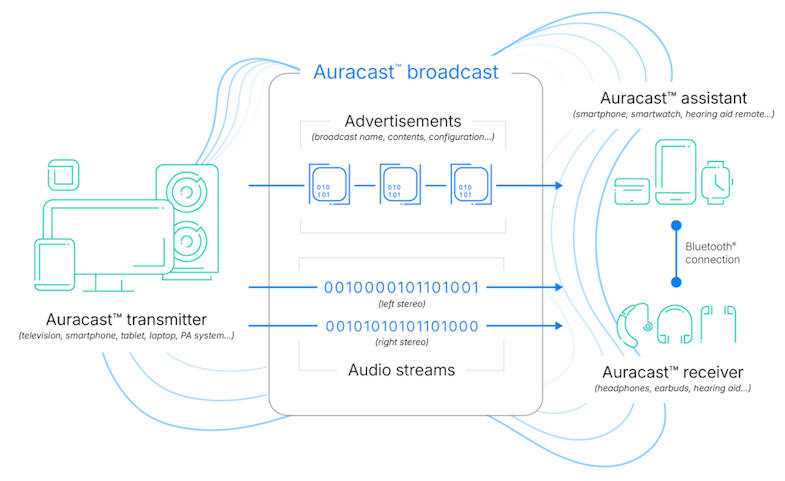
Unlike classic Bluetooth, which only requires a transmitter and a receiver, an Auracast network conceptually involves a triad of roles. Understanding these roles is vital to navigating the Auracast transmitter requirements.
A. The Broadcaster (The Source)
This is the device generating the audio and the Broadcast Isochronous Stream (BIS). It could be a public television in a gym, a PA system in an airport, or your personal smartphone sharing a Spotify playlist.
The Broadcaster's RF behavior is unique. Instead of entering a “pairing mode,” it utilizes Extended Advertising. It broadcasts a continuous train of data packets containing a Broadcast ID, the name of the stream (e.g., “Gate 4B Announcements”), and metadata about the audio quality.
B. The Receiver (The Sink)
These are your earbuds, headphones, or hearing aids. To be compatible, the silicon inside the earbuds must support the Public Broadcast Profile (PBP) and possess the DSP power to decode the LC3 codec.
Critically, Receivers do not typically have screens. If you are standing in an airport with twenty different Auracast streams broadcasting simultaneously, your earbuds have no way of knowing which stream you want to listen to. This necessitates the third device.
C. The Assistant (The UI)
The Assistant is almost always your smartphone or smartwatch. The Assistant uses the Broadcast Audio Scan Service (BASS) to scan the local RF environment for Extended Advertising packets.
When you open the Bluetooth menu on an Auracast-enabled phone, it displays a list of available broadcasts, much like scanning for Wi-Fi networks. When you tap “Gate 4B Announcements,” your phone (the Assistant) sends a tiny packet of data to your earbuds (the Receiver) containing the specific Broadcast ID and the synchronization parameters.
Your earbuds then decouple from the Assistant, synchronize their internal clocks to the Broadcaster's Periodic Advertising (PA) train, and begin decoding the audio stream directly from the public transmitter.


5. The Protocol Stack: Public Broadcast Profile (PBP)
For engineers, the magic of Bluetooth Auracast technology lies in the Public Broadcast Profile (PBP). This profile defines exactly how the packets are structured to ensure universal interoperability between a Sony TV, an Apple iPhone, and Samsung earbuds.
The broadcast data is organized hierarchically:
- Extended Advertising Packets: These are broadcast on the primary Bluetooth advertising channels. They simply state: “An Auracast stream exists nearby; look at the PA train for details.”
- Periodic Advertising (PA) Train: This is a synchronized, predictable transmission. It contains the BASE (Basic Audio Announcements). The BASE provides the critical metadata: how many audio channels there are, the language of the broadcast, and the exact timing offsets required to tune into the payload.
- Broadcast Isochronous Group (BIG): This is the actual audio payload. A BIG can contain multiple separate audio streams (e.g., an English language track and a Spanish language track).
Because the PA train broadcasts exactly when the BIG packets will arrive, the Receiver (earbuds) can put its radio transceiver to sleep in between packets, waking up microseconds before the payload arrives. This micro-sleep architecture is why Auracast does not decimate the battery life of tiny hearing aids or wireless earbuds.
6. Hardware Requirements: The Transmitter Challenge
A common misconception is that Auracast can be enabled on older hardware via a firmware update. In 95% of cases, this is false.
To understand the Auracast transmitter requirements, we must look at the physical radio controller. Legacy Bluetooth chips lack the physical hardware controllers required to manage Isochronous Channels and Extended Advertising simultaneously.
If a gym wants to upgrade its older flatscreen TVs to support Auracast, they cannot simply update the software. They must plug in a dedicated Auracast USB/HDMI dongle. These external transmitters contain dedicated modern SoCs (System on a Chip), such as the Qualcomm S3 Gen 2 Sound platform or equivalent Nordic Semiconductor chips, which possess the hardware-level MAC (Media Access Control) logic to handle BIS topologies.
Even modern smartphones face hurdles. While a phone from 2023 might have a Bluetooth 5.3 chip, the OS kernel and the Bluetooth host stack (e.g., Android's Fluoride or Fluoride-replacement stack, “Gabeldorsche“) must be specifically rewritten to support BASS and the Assistant role.
7. Security and Encryption for Auracast: The End of Eavesdropping
Because Auracast broadcasts packets into the open air, a natural question arises regarding privacy. How do you prevent someone from tuning into a private broadcast from your laptop?
The Public Broadcast Profile supports two modes: Open and Encrypted.
- Open Broadcasts: Similar to open Wi-Fi, the payload is unencrypted. The BIG packets can be intercepted and decoded by any device possessing the Broadcast ID. This is used for public infrastructure (stadiums, airports).
- Encrypted Broadcasts: When sharing audio from your personal smartphone, the Broadcaster encrypts the LC3 payload using standard AES-CCM cryptography. To listen, the Receiver needs the Broadcast Code (essentially a password).
When you configure an encrypted broadcast, your phone (the Assistant) securely passes the Broadcast Code to your friends' earbuds over a standard, encrypted point-to-point Bluetooth link. Once their earbuds have the code, they can independently decrypt the public broadcast stream.
8. The Hearing Aid Revolution: Auracast vs. Telecoil
While tech enthusiasts view Auracast as a convenient way to share music, the medical audiology industry views it as the greatest technological leap in fifty years.
Historically, public audio accessibility for the hearing impaired relied on Telecoil (T-coil) technology. A venue would install a massive copper wire loop around the perimeter of a room and pump an analog audio signal through it, creating a fluctuating electromagnetic field. Hearing aids equipped with a copper T-coil would pick up this magnetic induction and convert it back to audio.
Telecoil is inherently flawed. It is subject to severe electromagnetic interference (EMI) from fluorescent lights and power lines, resulting in a poor Signal-to-Noise Ratio (SNR). Furthermore, magnetic field strength degrades exponentially with distance.
Auracast replaces the physical copper loop with a single digital RF transmitter. Because the transmission is direct, digital, and error-corrected via LC3, a hearing-impaired user sitting in the back row of a cinema receives the exact same pristine, noise-free 160 kbps audio stream as someone sitting in the front row. It entirely bypasses the acoustic degradation of the room's echo and the limitations of magnetic induction.
9. Real-World Implementation: The Flagship Landscape
As we move through 2026, the theoretical architecture of Auracast is finally materializing in consumer hardware, though adoption is staggered based on ecosystem philosophy.
- Samsung: Samsung has been the most aggressive pioneer of the Bluetooth LE Audio broadcast standard. Their Galaxy S24, S25, and S26 series act as flawless Assistants and Broadcasters, while the Galaxy Buds 3 Pro and Galaxy Buds 4 series act as Receivers. They have deeply integrated the Auracast UI into the One UI Bluetooth menu, making “finding a broadcast” as intuitive as finding Wi-Fi.
- Sony: Sony has integrated Bluetooth LE Audio and Auracast compatibility into their WF-1000XM6 and WH-1000XM6 products. However, because Sony does not manufacture smartphones with a massive market share, they rely heavily on Google's native implementation of BASS within the core Android OS to act as the Assistant.
- Apple: Apple remains the outlier. While their hardware is theoretically capable, Apple historically prefers proprietary protocols (like their W1/H1 chip-driven audio sharing) over open standards. While future AirPods may support Auracast for public infrastructure (to comply with accessibility laws for hearing aids), their personal device-to-device audio sharing remains securely locked behind the iOS walled garden.
![Samsung Galaxy Buds 4 Pro (2026) AI True Wireless Bluetooth Earbuds + $30 Gift Card, Hi-Res Audio, 2-Way Speaker, ANC 2.0, Optimized Comfort, IP57, Live Translation, Black [US Version, 2 Yr Warranty]](https://m.media-amazon.com/images/I/312AqnkRCdL._SL160_.jpg)
- BUNDLE: Prime members get an Amazon Gift Card when you order Samsung Galaxy Buds4 Pro. Select the gift card bundle variation for redemption. Gift card may ship separately.
- EXCEPTIONAL AUDIO: Catch details like never before. Designed with a High-Res Audio¹ 24-bit hi-fi codec, the latest Galaxy earbuds maintain the integrity of your favorite audio over Bluetooth.
- TWO-WAY SPEAKER: Enjoy every audio experience to the fullest with two speakers in both Buds, including a tweeter for rich highs and a woofer for deep, full lows.
- HD VOICE: Enjoy clear phone calls with Galaxy Buds4 Pro and Galaxy S26 Series² —they work together to deliver crisp and clear conversations.
- ANC 2.0: Wherever you go, Adaptive Active Noise Cancellation 2.0³ intelligently adapts in real time to provide stronger, smoother noise cancellation wherever you go.

Conclusion: The Public Acoustic Infrastructure
Auracast is not merely a feature; it is a new infrastructural layer for the physical world.
By escaping the mathematical constraints of the point-to-point Piconet and embracing the efficiency of the LC3 codec, Bluetooth has transformed from a personal area network into a public broadcasting medium. As airports replace garbled PA speakers with Auracast transmitters, and as gyms phase out outdated FM radio transmitters attached to treadmills, the concept of public audio is changing.
In the near future, the question will not be whether your earbuds can connect to your phone, but whether they possess the architecture to connect to the world around you.
This article is part of our Headphone 101 series, dedicated to demystifying the complex engineering behind modern acoustic technology. Explore our other technical deep-dives to master the hardware that drives your daily audio experience.
You may check Headphone 101 for detailed explanations of headphone technologies and terms.
For Bluetooth headphone guides, please check the Bluetooth headphones section.
The sports headphones section is dedicated to guides on sports headphones.
You may also reach us through our Facebook page.


Leave a Reply