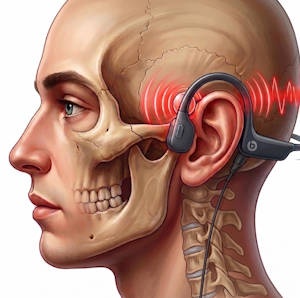
When we think of personal audio, we naturally think of the air. For over a century, headphone engineering has focused entirely on acoustic drivers pushing air molecules into our ear canals to vibrate our eardrums. However, a completely independent class of audio hardware has quietly matured into a dominant force in the consumer market: bone conduction audio.
If you want to understand how bone conduction headphones work past the marketing copy, you have to look directly at the biophysics of acoustic impedance and mechanical wave propagation. It is a world where your skull acts as a transmission medium, and where engineers must design hardware that battles the physical limitations of human bone.
In this comprehensive technical breakdown, we will isolate the physical differences between air and bone conduction pathways, dissect the core mechanical bottlenecks of solid-state transducers, and map out how input sensors utilize the same physics in reverse.
1. The Critical Distinction: Bone Conduction vs. Directional Air Audio
Before we dissect the biophysics of cranial mechanics, we must clear up a massive piece of marketing confusion. In the modern consumer audio space, the term “open-ear” is frequently used as a broad umbrella to describe two completely different physical technologies:
- True Bone Conduction: Uses electromechanical actuators to convert audio data into physical micro-vibrations. These waves completely bypass the air, the outer ear, and the eardrum, traveling directly through your temporal bone to stimulate the internal hearing organ (the cochlea).
- Open-Ear Directional Audio: Uses traditional moving-coil or planar magnetic drivers placed slightly outside the ear canal to project sound waves through the air (aka air conduction). It relies on advanced phase manipulation and acoustic dipole cancellation to keep the sound targeted at your ear canal while minimizing leakage to the outside world.
Editor's Note: If you are looking for headphones that clip onto your ear cartilage or glasses that use microscopic directional speakers (like the Ray-Ban Meta Smart AI Glasses, Bose Ultra Open Earbuds, or Nothing Ear Open), you are looking for Directional Air Conduction, which we tear down in our separate companion guide (coming soon). This article deals strictly with bone conduction.
2. The Biophysics of Hearing: Air vs. Bone Conduction
To understand why bone conduction feels fundamentally different from standard audio, we must trace the anatomical path that acoustic energy takes to reach your brain.
The Air Conduction Pathway
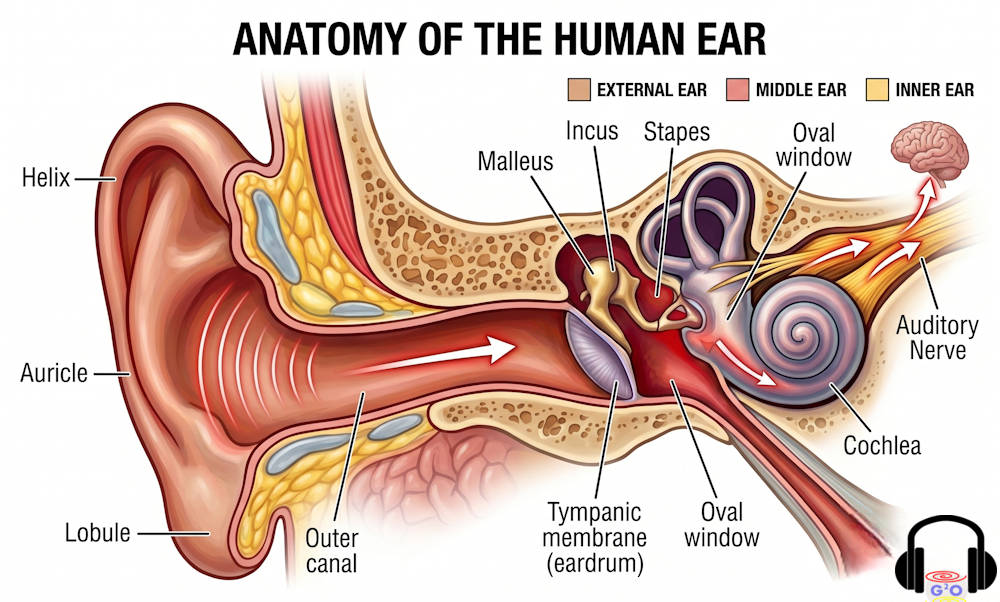
In traditional listening, sound waves (pressure variations in the air) are gathered by the pinna (outer ear) and directed down the external auditory canal. These waves hit the tympanic membrane (eardrum), causing it to vibrate. This mechanical movement is then amplified by three tiny bones in the middle ear—the malleus, incus, and stapes (the ossicles)—which act as a mechanical lever system to drive the fluid inside the snail-shaped cochlea. The fluid movement triggers thousands of microscopic hair cells (cilia), converting mechanical energy into electrical impulses sent down the auditory nerve, as illustrated in the picture below.
The Bone Conduction Pathway
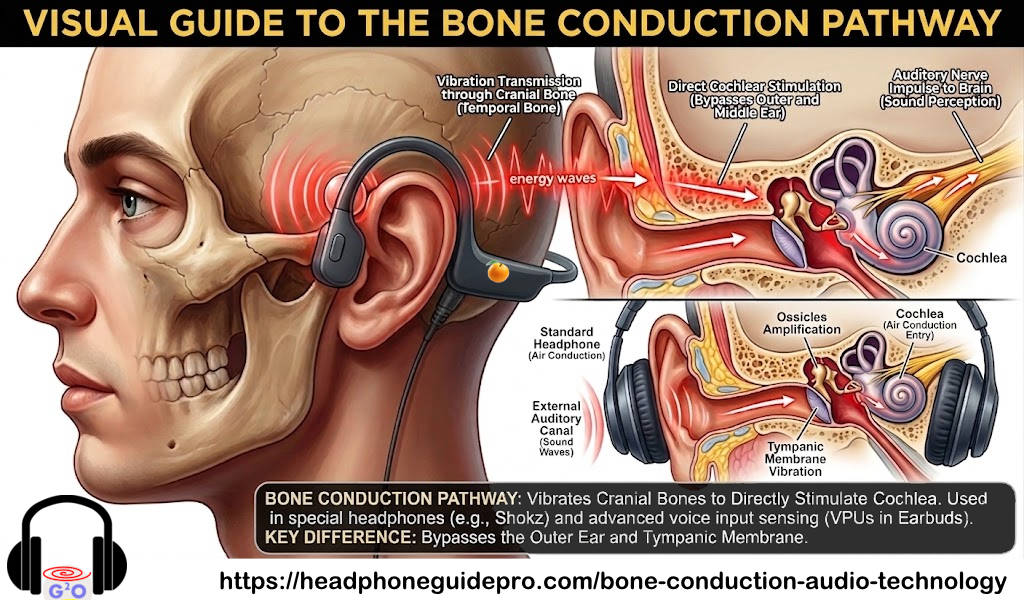
Bone conduction completely short-circuits this chain of events. When an actuator is placed against the temporal bone—specifically the mastoid process just behind the ear or the zygomatic arch just in front of it—its physical vibrations bypass the external auditory canal, the eardrum, and the ossicles entirely.
The physical vibrations travel directly through the rigid structure of the skull, as shown in the illustration below. This structural wave directly compresses and decompresses the bony capsule of the cochlea, which shifts the internal fluid and stimulates the hair cells exactly as an air-conducted sound would.
3. The Engineering Obstacles: The 2 kHz Wall and Acoustic Impedance
If bone conduction is so elegant, why hasn't it replaced traditional headphones? Because engineering a solid-state vibrator to sound good is a brutal battle against material science.

The 2 kHz Wall (Temporal Bone Attenuation)
The human skull is an exceptional low-pass filter. While low-frequency bass notes travel through bone with relatively low resistance, high-frequency vibrations are aggressively absorbed and attenuated by cranial tissue and bone sutures.
Above approximately 2 kHz, the transmission loss increases exponentially. This means that high-frequency audio components—such as the sparkle of a cymbal, the breathiness of a vocal, or critical sibilant consonants like /s/ and /f/—are naturally muffled by your own skull.
To combat this, engineers must design specialized DSP (Digital Signal Processing) algorithms that apply aggressive equalization curves, artificially boosting high frequencies to ensure they can punch through the bone.
The Acoustic Impedance Mismatch
In acoustics, impedance (Z) measures how much resistance a medium offers to a traveling sound wave. The acoustic impedance of air (Z_{air}) is incredibly low, while the acoustic impedance of human bone (Z_{bone}) is incredibly high.
When a sound wave tries to pass from a low-impedance medium to a high-impedance medium, the vast majority of the energy is reflected away rather than absorbed. We can mathematically model the energy transmission coefficient (T) between two mediums using their respective impedances:
T = \frac{4Z_1Z_2}{(Z_1 + Z_2)^2}
Because Z_{bone} \gg Z_{air}, a traditional speaker driver pushing air against your skin transfers almost zero vibrational energy to your bone; the energy simply bounces off.
To overcome this mismatch, bone conduction headphones use high-mass electromagnetic or piezoelectric actuators that press directly against the skin. This mechanical coupling minimizes the air gap, achieving a much tighter impedance match that allows kinetic energy to dump directly into the skeletal system.
Clamping Force vs. Ergonomics
Because physical contact is mandatory for energy transfer, the performance of a bone conduction headset is directly proportional to its clamping force. The firmer the headset presses against your temples, the better the bass response and high-frequency efficiency.
However, excessive clamping force causes localized tissue compression, leading to headaches and discomfort during long sessions. Engineers must balance the headband's spring-steel tension to hit an optimal window—typically between 1.2N and 1.8 N of force—to ensure acoustic transfer without causing physical fatigue.

- Unparalleled Audio and Premium sound – Dual drivers combine the clear highs of Bone Conduction Tech with the deep bass of Air Conduction Tech for 12 hours of powerful, 3D audio.Perfect for musical motivation during workouts and runs.
- Open-Ear Awareness – SHOKZ's signature open-ear design helps you power through your workouts while keeping you safely aware of your surroundings. Leak-free listening ensures your audio remains for your ears only
- Secure Stable, Lightweight Fit – The weight-optimized design of this unibody frame integrates a Ni-Ti alloy memory wire and ergonomic ear hooks. The result is a secure, comfortable fit that defies slips and shift even during gym sessions or cycling.
- Dedicated EQ Modes – Customize your audio experience with our dedicated EQ modes on the Shokz App. Enjoy pure bone conduction sound with the newly launched Classic Mode, or boost your audio in noisy environments with Volume Boost Mode.
- Crystal-Clear Calls – Strategically positioned dual wind-resistant microphones and an AI noise reduction algorithm filter out 96.5% of background noise, including wind at speeds of up to 15 miles per hour.
The Problem of Acoustic Leakage
Another engineering hurdle for how bone conduction headphones work as audio speakers is leakage. Because the transducer is vibrating the housing, it inevitably creates a small amount of air conduction sound.
To mitigate this, companies developed their own technologies, like “LeakSlayer” (Shokz)or anti-phase technology: they deliberately port a small amount of air-conducted sound in the opposite phase to cancel out the leakage that bystanders might hear.
4. Input vs. Output: Actuators and Voice Pickup Units (VPUs)
While consumer attention is usually focused on headphones that output audio via bone conduction, the technology has exploded in the opposite direction: as an input sensor to drastically improve phone call quality in True Wireless Stereo (TWS) earbuds.
Outbound Audio (Actuator)
Digital Stream ➔ DSP Correction ➔ Kinetic Transducer ➔ Temporal Bone ➔ Cochlea
Inbound voice (VPU Sensor)
Vocal Chords ➔ Jawbone Vibration ➔ Ear Canal Wall ➔ Accelerometer/VPU ➔ ML Noise Gate
Transducers (Output)
Modern bone conduction headphones use specialized electromagnetic actuators. Instead of a traditional voice coil moving a paper or plastic cone to vibrate the air, the coil moves a heavy internal mass suspended by precision springs. When alternating current flows through the coil, the shifting mass generates violent kinetic energy, driving the outer casing of the headphone housing to vibrate against the user's temple.
Voice Pickup Units (VPUs) and Call Quality
Standard MEMS (Micro-Electro-Mechanical Systems) microphones are “indiscriminate.” They capture all pressure waves in the air. While Beamforming and AI-denoising help, they struggle to separate a human voice from a background sound that occupies the same frequency, such as another person talking or wind noise hitting the microphone mesh.
If you look at modern flagship earbuds like the Apple AirPods Pro or Samsung Galaxy Buds Pro, they feature an internal Voice Pickup Unit (VPU). A VPU is essentially a bone conduction transducer running in reverse.
It is a microscopic, highly sensitive micro-electro-mechanical system (MEMS) accelerometer embedded inside the earbud tip that presses directly against your inner ear canal wall. When you speak, your vocal cords vibrate your jawbone and skull. The VPU detects these structural bone vibrations directly through your tissue. Why is this a game-changer for bone conduction call quality? Because wind, traffic, and background chatter do not vibrate your skull. The VPU acts as a flawless, physical acoustic gate: if the accelerometer doesn't detect jawbone vibration, the earbud’s processor knows that any sound picked up by the external microphones is ambient environmental noise, allowing the onboard machine learning models to scrub it away instantly.
5. Technical Limitations & Engineering Trade-offs
Despite its benefits, bone conduction remains limited by the physics of the human body:
- Acoustic Fidelity: The low-pass nature of bone transmission means you cannot achieve a flat 20Hz to 20 kHz response. Any claim of “audiophile” bone conduction is physically impossible due to the temporal bone's dampening of high-frequency harmonics.
- The “Tickle” Effect: To produce deep bass, the transducer must increase its excursion. At high volumes, this physical vibration exceeds the threshold of tactile perception, resulting in a distracting “crawling” sensation on the skin.
- Fitting Consistency: Air conduction is relatively forgiving of fit. Bone conduction requires a specific, high-pressure contact point (usually the temporal bone just in front of the tragus). If the contact is even slightly loose, the acoustic energy transfer drops exponentially according to the inverse-square law.

- Comfortable to Wear: Nothing Ear (Open) ultra-light open earbuds feature an ergonomic open ear hook design with a 50-degree tilt, a three-point balance, and skin-friendly silicone for all-day comfort and a secure fit. Please distinguish between left and right, and adjust the position of the earbuds into the ear according to the shape of your ear after wearing to bring you a better and more comfortable listening experience.
- Immersive Sound Quality: These open-ear headphones serve up rich bass and crisp treble, powered by an innovative stepped driver. Its uniquely shaped diaphragm, titanium alloy coating, and ultralight components deliver clear, balanced audio—making every note stand out.
- Bluetooth 5.3 & Seamless Dual Connection: These open-ear wireless earbuds feature the latest Bluetooth 5.3 for stable, low-latency audio—perfect for sports, fitness, travel, and office use. With multipoint pairing, they seamlessly switch between music and calls, delivering a hassle-free open audio experience with minimal setup. Whether you’re working out, commuting, or in meetings, the smooth dual connection elevates convenience in daily life and work.
- Clear Calls: Open-ear earbuds deliver clear calls via dual microphones and AI noise reduction, trained on 28 million samples. A sound isolation system minimizes leakage and protects privacy. Sound custom supported(EQ, low-latency gaming) via the Nothing X app. IP54 dust and water resistance make them ideal for any outdoor activities.
- Ultra-long battery life: These open-ear Bluetooth headphones offer 30 hours of combined playback. The earphones provide up to 8 hours of playtime, with a stylish transparent fast charging case extending it to 22 additional hours. All-day use effortless supported.

6. The Future of Bone Condunction Audio
As we look toward the next generation of acoustic hardware, bone conduction is evolving from simple vibration to precision sensing.
Piezoelectric MEMS VPUs
The next frontier is the transition from traditional accelerometers to Piezoelectric MEMS . These sensors are etched directly onto silicon, allowing for microscopic VPUs that consume microwatts of power. Because they are immune to electromagnetic interference (EMI) from the earbud's own internal radios, they provide a much cleaner signal for the DSP to analyze.
Synthetic High-Frequency Reconstruction
Engineers are currently developing AI models that use the bone-conducted signal (<3 kHz) as a “seed” to synthetically reconstruct the missing high-frequency harmonics of a user's voice. By analyzing the unique “vocal signature” captured through the skull, an onboard NPU can fill in the detail that standard microphones might lose in a high-wind environment, leading to the first truly “unbreakable” call quality.
Biometric Authentication
Because every human skull has a unique density, shape, and resonant frequency, bone conduction transducers are being trialed as biometric sensors. By playing a “silent” ultrasonic pulse through the temporal bone and measuring the reflection, headphones could theoretically authenticate the user's identity—creating a “Skull-ID” for secure mobile payments and private data access.
7. Summary: Beyond the Eardrum
Bone conduction is no longer a gimmick for marathon runners or a specialized medical tool. By leveraging the temporal bone as both a speaker and a high-fidelity sensor, engineers have found a way to bypass the limitations of the air-conduction bottleneck.
Whether it is the safety of an open-ear design or the crystal-clear call quality of a bone-sensor-gated microphone array, the future of personal audio is increasingly relying on the very skeleton of the listener.
This article is part of our Headphone 101 series, dedicated to demystifying the complex engineering behind modern acoustic technology. Explore our other technical deep-dives to master the hardware that drives your daily audio experience.
You may check Headphone 101 for detailed explanations of headphone technologies and terms.
For Bluetooth headphone guides, please check the Bluetooth headphones section.
The sports headphones section is dedicated to guides on sports headphones.
You may also reach us through our Facebook page.


Leave a Reply