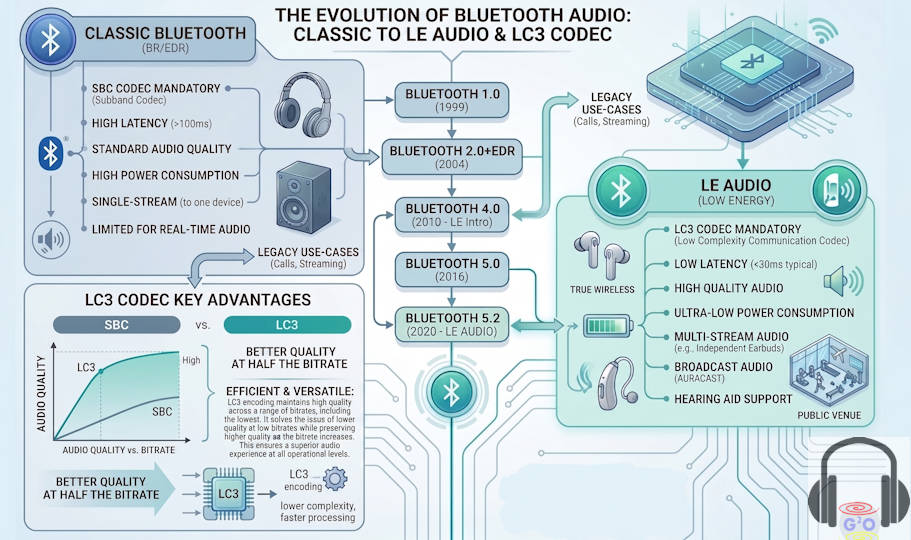
For over two decades, the wireless audio industry has been wrestling with a protocol that was never originally designed for high-fidelity music. When you listen to a podcast on standard Bluetooth earbuds and headphones, you are utilizing an architecture—Classic Bluetooth (BR/EDR)—that traces its roots back to 1999. It is power-hungry, prone to latency, and mathematically inefficient.
The introduction of Bluetooth 5.2 fundamentally changed this trajectory. By taking the Low Energy (LE) radio state—which was previously restricted to simple, intermittent IoT data like smartwatch heart rates—and re-engineering its MAC (Media Access Control) layer to support continuous audio, the Bluetooth Special Interest Group (SIG) executed the largest architectural rewrite in the protocol's history.
If you want Bluetooth LE Audio explained beyond the marketing bullet points, you must look at the protocol stack. In this technical deep-dive, we will dissect the failure points of Classic Bluetooth, the implementation of Isochronous Channels, the mathematical superiority of the LC3 codec, and how the new Bluetooth LE Audio architecture finally solves the master-slave problem that has plagued True Wireless Stereo (TWS) earbuds for years.
1. The Breaking Point: LE Audio vs Classic Bluetooth
To understand why LE Audio was necessary, we must understand the fundamental flaws of the Advanced Audio Distribution Profile (A2DP) running over Classic Bluetooth (Basic Rate / Enhanced Data Rate, or BR/EDR).
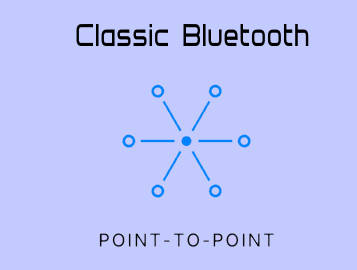
Classic Bluetooth operates on a connection-oriented “Piconet” topology. It relies on an asynchronous, polling-based data transfer method. When your phone sends an audio packet to your earbuds, it must wait for an Acknowledgment (ACK) packet to confirm receipt. If the 2.4 GHz spectrum is crowded (by Wi-Fi routers or microwaves) and the packet drops, the phone must re-transmit it.
To prevent the audio from stuttering during these re-transmissions, A2DP requires a massive audio buffer at the receiver (the earbud or headphone). This buffer is the primary source of Bluetooth latency, frequently introducing a delay (t_{delay}) of 150 ms to 250 ms, making it virtually useless for competitive gaming or real-time video editing.
Furthermore, Classic Bluetooth is incredibly power inefficient. Maintaining the BR/EDR radio link requires a constant, high-current draw, which is why early wireless earbuds struggled to surpass three hours of battery life.
The LE Audio vs Classic Bluetooth debate is not an iterative comparison; it is a complete structural replacement. LE Audio discards the BR/EDR radio completely, shifting continuous, high-bandwidth audio streams onto the ultra-low-power LE radio state.
![Apple Watch Series 11 [GPS 42mm] Smartwatch with Rose Gold Aluminum Case with Light Blush Sport Band - S/M. Sleep Score, Fitness Tracker, Health Monitoring, Always-On Display, Water Resistant](https://m.media-amazon.com/images/I/31J+F-pXaWL._SL160_.jpg)


2. The Architectural Core of Bluetooth LE Audio: Isochronous Channels (ISOC)
The foundational technology that enables LE Audio is the introduction of Isochronous Channels (ISOC) at the Link Layer.
In digital telecommunications, an “isochronous” stream is a time-bound data delivery mechanism. Packets of data are given a strict expiration date. If a packet is delayed due to RF interference, the receiver simply drops it and plays the next arriving packet, rather than pausing the entire stream to wait for a re-transmission. This aggressively minimizes latency.
ISOC architecture in Bluetooth LE Audio is divided into two distinct logical transports:
A. Connected Isochronous Streams (CIS)
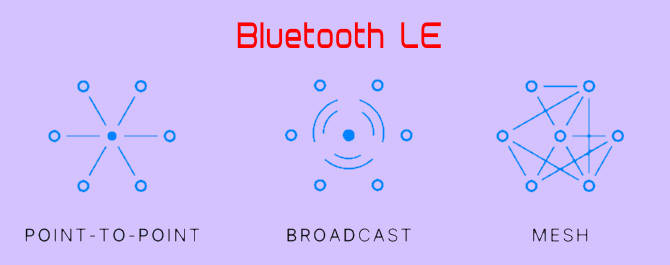
CIS is a bidirectional, point-to-point topology. It allows a single central device (a smartphone) to create multiple, perfectly synchronized, independent data streams to peripheral devices (the left and right earbuds). We will explore why this is critical for TWS earbuds in Section 4.
B. Broadcast Isochronous Streams (BIS)
BIS is a unidirectional, point-to-multipoint topology. It allows a central device to broadcast an audio stream into the ether without establishing a formal connection (handshake) with the receiving devices. This specific ISOC implementation is the underlying engine that powers Auracast technology, allowing infinite scalability in public acoustic infrastructure.
3. The Engine: LC3 Codec vs SBC
You cannot simply pipe legacy audio codecs over low-energy radio waves. The limited bandwidth of the LE radio state required the invention of a hyper-efficient compression algorithm. The result is the Low Complexity Communications Codec, or LC3.
Under the A2DP standard, the mandatory fallback codec was SBC (Subband Codec). SBC is mathematically archaic. To achieve a baseline level of transparent audio quality, SBC requires a relatively high bitrate—typically around 328 kbps or 345 kbps.
In the LC3 codec vs SBC comparison, LC3 achieves superior psychoacoustic transparency at exactly half the bitrate.


The Mathematics of MDCT
LC3 achieves this efficiency through a block-based Modified Discrete Cosine Transform (MDCT). MDCT is a Fourier-related transform based on the type-IV discrete cosine transform, with the critical addition of overlapping windows.
When analog sound is digitized, the continuous wave is sampled. The relationship between the sample rate (f_s), the frame duration (t_{frame}), and the resulting block size (L) in samples is absolute:
L=f_s\times t_{frame}Legacy codecs like SBC use long frame durations (often 20 ms or more) and rely heavily on the time domain. This inherently introduces algorithmic delay.
LC3 dynamically shifts into the frequency domain using MDCT. It can operate at incredibly short frame durations of exactly 10 ms or an ultra-low 7.5 ms. By utilizing overlapping windows, MDCT prevents the “clicking” or “popping” artifacts (time-domain aliasing) that normally occur when stitching tiny, compressed audio blocks back together.
The result? LC3 can deliver pristine, transparent audio at just 160 kbps. Because the packets are half the size of SBC, the radio transceiver spends less time transmitting, which slashes power consumption and drastically increases the earbuds' battery life.
4. Multi-Stream Audio and the Death of TWS Sniffing
To truly appreciate how LE Audio works in the real world, we must look at how it solves the most persistent engineering headache in modern audio: the True Wireless Stereo (TWS) master-slave problem.
In the Classic Bluetooth era, a smartphone could only maintain an A2DP audio stream with a single endpoint. To make two independent earbuds play stereo sound, manufacturers had to employ “Cross-Head Bluetooth Transmission.”
The smartphone would transmit the full stereo signal to the Primary Earbud (Master). The Primary Earbud would process the signal, strip out, for example, the left channel for itself, and then re-transmit the right channel through the user's skull to the Secondary Earbud (Slave).
This is an acoustic nightmare due to the “Head-Shadow Effect.” Human tissue and bone absorb 2.4 GHz radio waves incredibly well. The connection between the left and right earbuds was highly susceptible to dropping out, and the Primary Earbud drained its battery twice as fast because it was acting as both a receiver and a transmitter.
LE Audio's Multi-Stream Audio utilizes Connected Isochronous Streams (CIS) to eradicate this problem. The smartphone's radio controller creates two separate, parallel ISOC channels. It transmits the left channel exclusively to the left earbud and the right channel exclusively to the right earbud.
Because both channels share a synchronized CIG (Connected Isochronous Group) timing reference, the audio playback is perfectly aligned down to the microsecond. The head-shadow effect is bypassed entirely, battery drain is equalized across both earbuds, and the connection stability in crowded environments skyrockets.
![Samsung Galaxy Buds 4 (2026) AI True Wireless Bluetooth Earbuds + $20 Gift Card, Noise Cancelling, Hi-Res Audio, 1-Way Speaker, New Fit, IP54, Live Translation, Black [US Version, 2 Yr Warranty]](https://m.media-amazon.com/images/I/31lBrdEkiML._SL160_.jpg)

5. The Audiophile Myth: LC3plus and High-Res LE Audio
A common misconception regarding LE Audio is that because it is designed for “Low Energy,” it cannot support high-resolution audiophile playback.
It is vital to understand that the standard LC3 codec is the mandatory baseline. It replaces SBC to ensure that all Bluetooth 5.2+ devices can communicate efficiently. However, the LE Audio architecture fully supports the transmission of vendor-specific, high-bitrate codecs over its Isochronous Channels.
If you pair modern Sony earbuds (e.g., WF-1000XM6) to an Xperia smartphone, the devices will perform a digital handshake over the LE radio, recognize mutual compatibility, and scale up to transmit LDAC audio data over the ISOC link. Similarly, Samsung Seamless Codec can be used between a Galaxy phone and Galaxy Buds 4.
Furthermore, the Fraunhofer Institute (one of the inventors of LC3) have released the LC3plus codec. LC3plus is a high-resolution extension officially certified by the Japan Audio Society for “Hi-Res Audio Wireless.” It leverages the MDCT efficiency of LC3 but scales up to a 24-bit depth and a 96 kHz sampling rate. In the near future, LC3plus will likely serve as a universal, open-standard rival to proprietary codecs like Qualcomm's aptX Adaptive and Sony's LDAC.
6. Hardware Requirements: Why You Can't Simply “Update” to Bluetooth LE Audio
If Bluetooth LE Audio is so mathematically superior, why isn't it available on every device today? The answer lies in the silicon.
Bluetooth is comprised of a Host (the operating system, like Android or iOS) and a Controller (the physical radio chip). You cannot enable LE Audio on a Bluetooth 5.0 device via a firmware update because the physical Controller lacks the hardware-level MAC logic required to generate Isochronous Channels.
To utilize Bluetooth LE Audio, both the source device (the smartphone) and the sink device (the earbuds/Bluetooth headphones) must possess a Bluetooth 5.2 or newer Controller. Furthermore, the Host OS must contain a Bluetooth LE Audio-compliant software stack. This strict hardware dependency is why the transition from Classic Bluetooth to LE Audio is taking several years, rolling out generation by generation as older silicon is phased out.
Conclusion: The Quiet Revolution
Bluetooth LE Audio is not a marketing gimmick or a simple codec update; it is a fundamental re-engineering of wireless telecommunications.
By discarding the inefficient, polling-based architecture of Classic Bluetooth in favor of Isochronous Channels, and by replacing the archaic SBC standard with the mathematically rigorous LC3 codec, the industry has finally solved the latency, power, and stability issues that have plagued wireless audio for twenty years. It is the invisible infrastructure that makes modern innovations like Auracast and Super Wide Band voice possible, cementing it as the most critical acoustic technology of the decade.
This article is part of our Headphone 101 series, dedicated to demystifying the complex engineering behind modern acoustic technology. Explore our other technical deep-dives to master the hardware that drives your daily audio experience.
You may check Headphone 101 for detailed explanations of headphone technologies and terms.
For Bluetooth headphone guides, please check the Bluetooth headphones section.
The sports headphones section is dedicated to guides on sports headphones.
You may also reach us through our Facebook page.


Leave a Reply