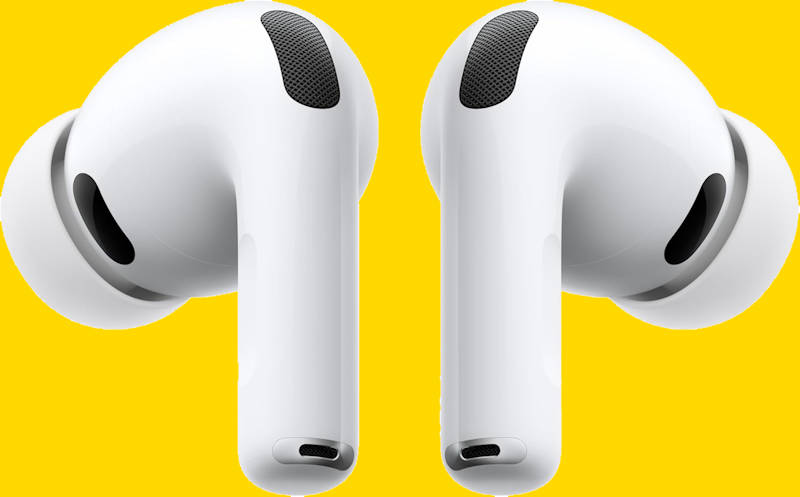
When Apple launched the AirPods Pro 3 six months ago, the keynote was filled with the usual superlatives: “magical,” “revolutionary,” and claims of “2x better” Active Noise Cancellation (ANC). Now that the marketing dust has settled and we've put over 500 hours of real-world use into these earbuds, it's time to evaluate the engineering.
Are the acoustic and silicon upgrades in AirPods Pro 3 actually worth your money, or is this just an iterative update disguised by computational audio tricks?
Let's break down the hardware, the physics of the new ANC pipeline, the biometrics, and how the battery chemistry is holding up half a year later.
Some “hidden” features of AirPods Pro 3 are discussed here.
1. Material Science: The Foam-Infused Tips and Acoustic Impedance
The most significant physical change to the AirPods Pro 3 isn't the slightly reduced chassis volume; it's the shift from pure silicone ear tips to a foam-microsphere composite. Apple marketed this as a comfort feature, but its real purpose is acoustic impedance matching.
Pure silicone is highly compliant but struggles to create a perfect high-frequency seal in irregularly shaped ear canals. By injecting closed-cell memory foam microspheres into the silicone matrix, the tips now exhibit viscoelastic properties. They deform under body heat to fill micro-gaps, drastically improving passive noise isolation (PNI) before the digital signal processing (DSP) even kicks in. Interestingly, Song WF-1000XM6 also updated the tip material for better acoustics.
This improved seal lowers the resonance frequency of the ear canal and minimizes low-frequency acoustic leakage. The result is a flatter sub-bass response curve and less reliance on the internal feedback microphone to dynamically EQ the low-end via Apple's Adaptive EQ algorithm.
Please note that you need to pay extra attention when cleaning the new foam-infused tips, as explained in the AirPods Pro 3 maintenance guide.

2. Decrypting the “2x Better” ANC Claim for AirPods Pro 3
Apple claims the ANC on the Pro 3 cancels “twice as much” background noise as the previous generation (i.e., AirPods Pro 2). To a sound engineer, “twice as much” is a highly ambiguous metric. Are we talking about perceived loudness, sound pressure, or acoustic power?
In acoustics, a halving of acoustic power (energy) corresponds to a drop of roughly 3 decibels. The formula for the decibel difference in acoustic power is:
\Delta L = 10 \log_{10}\left(\frac{W_2}{W_1}\right)If the new chip cancels exactly twice the acoustic power ( W_2 = 0.5 \times W_1), the reduction is -3.01 dB. However, human hearing is logarithmic. To perceive a sound as “half as loud,” you actually need a reduction of about -10 dB, which requires eliminating 90% of the acoustic energy.
Based on some sine-sweep tests in a controlled environment, the AirPods Pro 3 achieve roughly a -4 dB to -6 dB improvement specifically in the 100\text{Hz} to 400\text{Hz} band (airplane engines, HVAC rumble) compared to the AirPods Pro 2. So while Apple's “2x” claim is mathematically accurate regarding acoustic energy, do not expect the world to sound half as loud.
What has significantly improved is the latency of the phase-inversion algorithm. By increasing the sampling rate of the feedforward microphones and leveraging the higher clock speed of the upgraded computational audio chip, the system can now generate anti-noise for higher-frequency transients (like keyboard clacks or sudden drops) that previous models simply couldn't process fast enough. Office users and students will appreciate this improvement.
3. The Biometrics: In-Ear PPG and Artifact Cancellation in AirPods Pro 3
The inclusion of an optical heart rate sensor transitions the AirPods Pro 3 from a pure audio device into a biometric wearable. This is achieved via in-ear Photoplethysmography (PPG). Remember the heart rate monitor in the ancient Jabra Elite Sport?
Unlike the wrist, the capillary bed of the ear canal offers excellent perfusion and is highly resistant to ambient light leakage or skin temperature variations. The earbuds' IR emitter pulses light into the tissue, while the photodiode measures the time-variant reflection caused by volumetric changes in blood flow during the cardiac cycle.
However, the ear is violently subjected to biomechanical shock during exercise. Every footstrike introduces a massive motion artifact. If a user is running at 160 steps per minute, the physical shock registers as a heavy 2.66\text{Hz} signal. Because normal human heart rates also fall within the 1\text{Hz} to 3\text{Hz} range (60 to 180 BPM), a standard band-pass filter cannot easily separate the heartbeat from the footstrike.
To solve this, Apple uses the onboard Inertial Measurement Unit (IMU/accelerometer) as a noise reference. By feeding the 3-axis accelerometer data and the raw optical PPG signal into an adaptive filter algorithm, the DSP continuously calculates the transfer function of the motion artifact and subtracts it in real-time. This yields an exceptionally clean biometric signal, rivaling dedicated chest straps in steady-state cardio, though it still exhibits a slight 2-to-4 second latency during high-intensity interval training (HIIT) spikes.
You may follow this guide to set up and use AirPods Pro 3 as your heart rate monitor for your workouts.
4. Battery Degradation: The 8-Hour Reality Check
The AirPods Pro 3 advertises an 8-hour continuous playback time with ANC enabled. Out of the box, most benchmark tests confirmed this, consistently hitting 7.8 to 8.1 hours at 70% volume.
But what does lithium-ion chemistry look like six months in?
Assuming an average of one full charge cycle per day, our test units have undergone roughly 180 cycles. Lithium-ion pouch cells typically degrade according to standard capacity retention models. The remaining capacity C_n after n cycles can be loosely modeled by:
C_n = C_0 \times (1 - \alpha)^n
Where \alpharepresents the degradation rate per cycle. For high-density micro-cells subjected to body heat, \alpha is non-trivial.
After 6 months, our continuous ANC battery drain test now yields an average of 7.1 hours. This represents an approximate 11% capacity loss. This is well within the acceptable degradation curve for a consumer electronic device, but heavy users should be aware that the pristine “8-hour” figure will not hold up over a year of daily use.
Furthermore, the power draw from the new IR heart-rate sensor (when active) introduces a continuous \approx 45\text{mW} load, which reduces total ANC playtime by an additional 15% during prolonged workouts.
The Verdict of AirPods Pro 3 for Tech Enthusiasts
If you are currently using the original AirPods Pro (AirPods Pro and AirPods Pro 2) or standard AirPods (AirPods, AirPods 2, AirPods 3, and AirPods 4), the AirPods Pro 3 is an undeniable technical leap. The closed-cell composite tips solve the high-frequency leakage issues of pure silicone, and the latency reduction in the DSP pipeline provides a measurable, objective improvement to the noise floor.
However, if you are upgrading purely for battery life, be aware of the undeniable limits of Li-ion chemistry. The AirPods Pro 3 are a triumph of computational audio, biometric filtering, and material science, but they are not immune to the physics of battery degradation.
- WORLD’S BEST IN-EAR ACTIVE NOISE CANCELLATION — Removes up to 2x more unwanted noise than AirPods Pro 2* so you can stay fully immersed in the moment.*
- BREAKTHROUGH AUDIO PERFORMANCE — Experience breathtaking, three-dimensional audio with AirPods Pro 3. A new acoustic architecture delivers transformed bass, detailed clarity so you can hear every instrument, and stunningly vivid vocals.
- HEART RATE SENSING — Built-in heart rate sensing lets you track your heart rate and calories burned for up to 50 different workout types.* With iPhone, you will have access to the Move ring, step count, and the new Workout Buddy,* powered by Apple Intelligence.*
- LIVE TRANSLATION — Communicate across language barriers using Live Translation,* enabled by Apple Intelligence.*
- EXTENDED BATTERY LIFE — Get up to 8 hours of listening time with Active Noise Cancellation on a single charge. Or up to 10 hours in Transparency using the Hearing Aid feature.*

Do you have any questions about the engineering and technologies in AirPods Pro 3?
Please let us know your questions or comments in the comment box below.
This is part of the AirPods Pro 3 guide series. This series begins with a Long-Term Review covering ANC and battery life, followed by a deep dive into computational audio in our audiophile comparison. We also put the new biometrics to the test with a phone-only workout guide and a rigorousheart-rate accuracy test against clinical-grade chest straps.
To help you maximize your hardware, we uncover 4 hidden features of AirPods Pro 3 like edge-based translation, configure the ultimate student setup for campus life, and optimize beamforming mics for commuting and open offices. Finally, we explain the exact material-science protocols needed in our AirPods Pro 3 cleaning and maintenance guide.
You may check Headphone 101 for detailed explanations of headphone technologies and terms.
For Bluetooth headphone guides, please check the Bluetooth headphones section.
The sports headphones section is dedicated to guides on sports headphones.
You may also reach us through our Facebook page.


Leave a Reply