The true wireless stereo (TWS) earbuds market has arguably been stagnating for the past two product cycles. Iterative driver tweaks and software-gated features have largely replaced genuine hardware innovation. However, with the Galaxy Unpacked event in February 2026, Samsung signaled a definitive shift. Launched alongside the new flagship smartphones, Galaxy Buds 4 and Galaxy Buds 4 Pro are positioned not just as peripherals but as the premier Galaxy S26 ecosystem accessories.
With the Samsung Galaxy Buds 4 release date officially slated for March 11, 2026, audiophiles and tech enthusiasts finally have their hands on the spec sheets. The new lineup—consisting of the $179 open-fit Galaxy Buds 4 and the $249 canal-fit Galaxy Buds 4 Pro—represents a fundamental teardown and rebuild of Samsung’s acoustic and physical architecture.
In this deep-dive series on Galaxy Buds 4 and Galaxy Buds 4 Pro, we strip away the marketing gloss to examine the raw hardware changes, the acoustic engineering, and the highly debated ecosystem lock-ins that define this new generation.
Ergonomics and the Galaxy Buds 4 Blade Design
Samsung’s design language has historically been somewhat erratic, bouncing from the bean-shaped Galaxy Buds Live to the stemless Galaxy Buds Pro and Galaxy Buds 2 Pro, and recently to the angular, cyberpunk-esque triangular stems of the Galaxy Buds 3 and Galaxy Buds 3 Pro. For 2026, Samsung has pivoted again, but this time driven by empirical data rather than pure aesthetics.
The new Galaxy Buds 4 blade design is the result of computational modeling utilizing over 100 million global ear data points. The most notable physical change is the transition from a sharp, triangular stem to a flatter, metallic-finished “blade.”
From a purely functional standpoint, this is a massive ergonomic upgrade. The flat surface provides a significantly wider and more tactile area for the integrated force sensors (similar to that on AirPods) . If you found the pinch-and-swipe gestures on previous iterations to be finicky or prone to misfires when walking or running, the blade design mitigates this by offering a defined, engraved pinch-control area.
Weight distribution has also been meticulously tuned. The Galaxy Buds 4 Pro weighs in at exactly 5.1g per bud, while the standard Buds 4 sits at 4.6g. By slightly angling the nozzle and redistributing the battery mass higher into the concha, Samsung has reduced the pendulum effect that often plagues stemmed earbuds during high-impact movement.
However, it is not entirely flawless. For a flagship device catering to the audiophile crowd, Samsung’s decision to include only three sizes of silicone ear tips for the Galaxy Buds 4 Pro model is a glaring omission. Getting a perfect acoustic seal is the foundational requirement for both low-end frequency response and passive noise isolation. Competitors, e.g., Sony WF-1000XM6 and AirPods Pro 3, routinely offer four or five tip sizes, and Samsung's rigid adherence to small, medium, and large feels surprisingly stingy.
![Samsung Galaxy Buds 4 (2026) AI True Wireless Bluetooth Earbuds + $20 Gift Card, Noise Cancelling, Hi-Res Audio, 1-Way Speaker, New Fit, IP54, Live Translation, Black [US Version, 2 Yr Warranty]](https://m.media-amazon.com/images/I/31lBrdEkiML._SL160_.jpg)


Acoustic Architecture: Breaking Down the Galaxy Buds 4 Features
If you are a spec-hunter, the internal hardware of the Galaxy Buds 4 Pro model is where the most significant Galaxy Buds 4 features reside. Samsung has completely overhauled the driver array, opting for a true 2-way speaker system that borrows heavily from high-end in-ear monitor (IEM) engineering.
The Buds 4 Pro features an 11mm “Super Wide” dynamic woofer paired with a dedicated 5.5mm planar tweeter.
Why does this matter? In a standard single-driver setup (which the base $179 Galaxy Buds 4 still uses), a single dynamic diaphragm is forced to reproduce the entire frequency spectrum. Pushing deep sub-bass requires moving a high volume of air (high excursion), while rendering crisp, 15kHz+ treble requires lightning-fast, micro-vibrations. Forcing one driver to do both inevitably leads to intermodulation distortion and a muddying of the midrange.
By utilizing a crossover network to split these duties, Galaxy Buds 4 Pro allows the 11mm woofer to focus entirely on the low-end. Samsung claims this new woofer design maximizes the vibration area by nearly 20% compared to the Galaxy Buds 3 Pro by minimizing the speaker’s edge suspension. The result is a much tighter, more authoritative sub-bass extension without the mid-bass bloat that typically ruins the lower-mids.
Handling the highs is the 5.5mm planar tweeter. Planar magnetic drivers use a flat diaphragm embedded with a wire trace, suspended between magnets. Because the diaphragm is exceptionally thin and low-mass, its transient response—the speed at which it can start and stop moving—is vastly superior to traditional dynamic tweeters. This translates to exceptional detail retrieval. The attack and decay of cymbals, the breathiness of a vocal track, and the sheer “air” in a high-resolution recording are reproduced with clinical precision.
The Walled Garden of 24-bit Audio
There is, however, a massive caveat to this acoustic hardware: codec support. The Galaxy Buds 4 Pro is capable of 24-bit/96kHz Ultra High Quality (UHQ) audio, but it is entirely gated behind the Samsung Seamless Codec (SSC).
If you are using a Galaxy S26, S25, or a recent Galaxy Z Fold with One UI 6.1.1 or higher, you will experience the full, uncompressed bandwidth. If you are using a Google Pixel, a Sony Xperia, or an iPhone, you are immediately downgraded to the standard SBC or AAC codecs. There is no support for universally adopted high-res codecs like Sony's LDAC or Qualcomm's aptX Adaptive. For the audiophile who refuses to be locked into a single smartphone manufacturer, this is a frustrating, anti-consumer limitation.
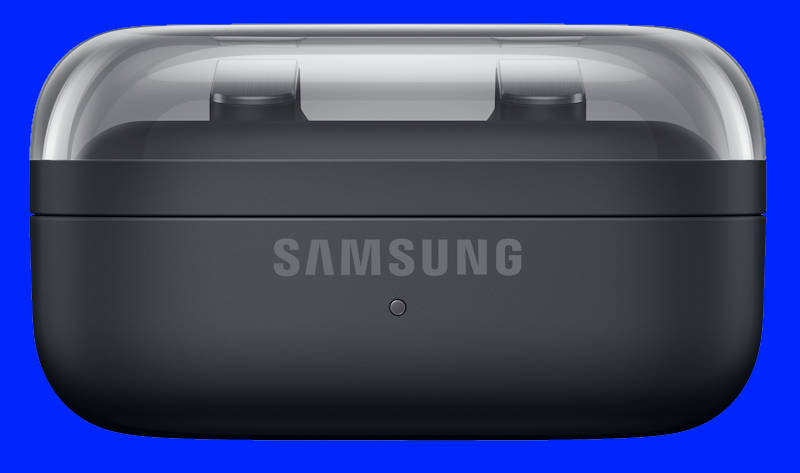
The Return of the Clamshell: Samsung Galaxy Buds 4 Case Transparent Lid
Moving to the charging cradle, Samsung has abandoned the vertical drop-in cases of the past few years in favor of a horizontal, jewelry-box style clamshell.
The defining visual characteristic here is the Samsung Galaxy Buds 4 case's transparent lid. While aesthetic, it serves a practical purpose: allowing users to verify their earbuds are seated and charging without having to open the case and trigger a Bluetooth handshake with their phone.
Measuring at 51x51x38mm and weighing roughly 44g, the case is highly pocketable. The hinge mechanism feels reinforced, snapping shut with a satisfying, high-tension magnetic click. It supports Qi wireless charging and houses a 530mAh battery (for the Pro model), which supplies enough juice to bump the earbuds' 6 hours of ANC playback up to a total of 26 hours.
![Samsung Galaxy Buds 4 Pro (2026) AI True Wireless Bluetooth Earbuds + $30 Gift Card, Hi-Res Audio, 2-Way Speaker, ANC 2.0, Optimized Comfort, IP57, Live Translation, Black [US Version, 2 Yr Warranty]](https://headphoneguidepro.com/wp-content/plugins/aawp/assets/img/placeholder-large.jpg)
- BUNDLE: Prime members get an Amazon Gift Card when you order Samsung Galaxy Buds4 Pro. Select the gift card bundle variation for redemption. Gift card may ship separately.
- EXCEPTIONAL AUDIO: Catch details like never before. Designed with a High-Res Audio¹ 24-bit hi-fi codec, the latest Galaxy earbuds maintain the integrity of your favorite audio over Bluetooth.
- TWO-WAY SPEAKER: Enjoy every audio experience to the fullest with two speakers in both Buds, including a tweeter for rich highs and a woofer for deep, full lows.
- HD VOICE: Enjoy clear phone calls with Galaxy Buds4 Pro and Galaxy S26 Series² —they work together to deliver crisp and clear conversations.
- ANC 2.0: Wherever you go, Adaptive Active Noise Cancellation 2.0³ intelligently adapts in real time to provide stronger, smoother noise cancellation wherever you go.
Pioneering Bluetooth 6.1 Earbuds in 2026
Underpinning the entire system is the move to the latest wireless standard. Being among the first true Bluetooth 6.1 earbuds 2026 has to offer, the Galaxy Buds 4 series brings significant underlying improvements to connection stability and energy efficiency.
Bluetooth 6.1 refines the Isochronous Channels (ISOC) introduced in LE Audio, allowing for perfectly synchronized data streams to the left and right earbuds independently. This drastically reduces latency—a critical metric for mobile gamers and video editors.
Furthermore, both the standard and Pro models fully support Auracast. While still in its infancy regarding public infrastructure, Auracast allows you to tune into public audio broadcasts (such as a muted TV in a sports bar, or flight announcements at an airport gate) directly through your earbuds without needing to pair to the source device. It is a highly forward-looking inclusion that future-proofs the hardware.
Early Verdict: A Technical Leap with Ecosystem Strings Attached
The Galaxy Buds 4 and Galaxy Buds 4 Pro represent a massive leap forward in Samsung’s acoustic engineering. The shift to a planar tweeter and an enlarged woofer in the Pro model yields a sound signature that easily rivals the heavyweights from Sony and Sennheiser in pure detail retrieval and staging. The blade design, while initially jarring, proves to be a triumph of ergonomic utility over pure visual flair.
However, the hardware's true potential remains strictly fenced within the Samsung ecosystem. If you are already planning to upgrade to the Galaxy S26, the Galaxy Buds 4 Pro are essentially a mandatory purchase. They are heavily optimized to leverage the phone's processing power for 24-bit audio (you need the Sony WF-1000XM6 to get 32-bit audio) and advanced AI features.
If you operate outside the Samsung bubble, the hardware excellence is severely bottlenecked by software limitations, forcing you to ask whether the premium price tag is justified for AAC-tier audio.
If you have any questions about new features of Galaxy Buds 4 and Galaxy Buds 4 Pro, please let us know in the comment box below.
This article is part of our comprehensive 5-part technical guide to the Galaxy Buds 4 series. You can start from the beginning to explore the physical and acoustic evolution of the new hardware, or dive directly into our head-to-head metric comparison between the standard and Pro models. To see how Samsung's engineering stacks up against the wider industry, check out our flagship shootout against Apple, Sony, and Bose. For S26 power users, we have a masterclass on maximizing Galaxy AI, head gestures, and parametric EQ settings, and a scenario-based purchasing guide to help you find the perfect fit for your lifestyle.
You may check Headphone 101 for detailed explanations of headphone technologies and terms.
For Bluetooth headphone guides, please check the Bluetooth headphones section.
The sports headphones section is dedicated to guides on sports headphones.
You may also reach us through our Facebook page.


Leave a Reply