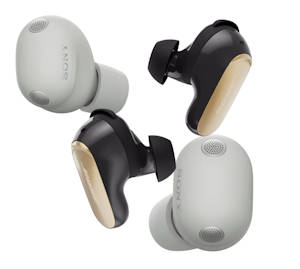
If the AirPods Pro are the lifestyle choice, the battle between Sony and Bose is the heavyweight title fight for pure engineering dominance.
For years, the narrative was simple: Bose had the best Active Noise Cancellation (ANC), and Sony had the best sound quality. With the release of the Bose QuietComfort Ultra Earbuds Gen 2 in June 2025, Bose narrowed the sound quality gap significantly. Now, with the Sony WF-1000XM6, Sony is attempting to steal the ANC crown.
This Sony WF-1000XM6 vs. Bose QC Ultra Gen 2 comparison is not about features or apps; it is about the decibel reduction curve. We are looking at who creates the purest void.
1. The ANC Architecture: CustomTune vs. QN3e (Sony WF-1000XM6 vs. Bose QC Ultra Earbuds Gen 2)
The approach to silence is fundamentally different between Framingham (Bose) and Tokyo (Sony). Here is the comparison of the approaches for Sony WF-1000XM6 vs. Bose QC Ultra Earbuds Gen 2.
Bose QC Ultra Earbuds Gen 2: The “Vacuum” Effect
The Bose QC Ultra Gen 2 utilizes an aggressive proprietary algorithm called CustomTune.
- The Chime: When you insert the buds, that sweeping tone isn't just a startup sound; it's a sonar ping. The mic measures the acoustic response of your specific ear canal and calibrates the anti-noise filter instantly.
- The Result: Bose achieves a terrifyingly high level of attenuation in the sub-bass frequencies (20~200Hz). It creates a physical sensation of pressure—a “vacuum” effect—that completely erases the drone of an airplane engine. It is effective, but for some users, it can be nauseating (the “eardrum suck” phenomenon).
Sony WF-1000XM6: The Natural Void
The Sony WF-1000XM6 relies on the sheer processing power of the QN3e chip and the new 8-microphone array.
- The Strategy: Rather than a brute-force vacuum, Sony targets specific frequencies with higher precision. The new 32-bit processor allows for more complex notch filters in the mid-range.
- The Result: Sony’s silence feels “lighter.” You don't feel the pressure change as intensely. While Bose might reduce a jet engine by 45 dB, Sony might hit 43dB —technically less, but practically indistinguishable.
The Edge:
- Deep Rumble (Planes/Trains): Bose wins. The floor drops out completely.
- Mid-Range (Voices/Office): Sony wins. The extra feedback microphones in the XM6 handle erratic human speech better than Bose’s algorithm, which prefers constant drones.

- WORLD-CLASS NOISE CANCELLATION: The best noise cancellation of any Bose wireless earbuds is now even better than before. ActiveSense technology smooths spikes in surrounding sound, so even in Aware Mode distractions won’t get in the way.
- CUSTOMTUNE TECHNOLOGY: CustomTune technology analyses your ears and adapts your in-ear headphones to their shape. The result? World-class noise cancellation and custom sound for bigger chills every time you press play.
- NOISE CONTROL: Quickly adjust the level of noise cancellation without using Modes, including turning it off completely to conserve battery.
- IMMERSIVE AUDIO: Bose Immersive Audio spatialises what you’re hearing by taking it out of your head and placing it beyond your Bluetooth earbuds. It’s like listening from the acoustic sweet spot, where songs sound like the artist intended.
- SECURE FIT AND STABILITY: Choose from nine combos of eartips and stability bands to find the snuggest fit for comfortable earbuds. The soft, umbrella-shaped tips seal the opening of your ear to reduce outside noises while stability bands hug them.

2. Sony WF-1000XM6 vs. Bose QC Ultra Earbuds Gen 2–Sound Quality: Computed Fun vs. High-Res Fidelity
Bose QC Ultra Earbuds Gen 2: Immersive Audio (The “Wow” Factor)
Bose’s killer feature remains Immersive Audio. This is an onboard virtualization that takes any stereo signal (Spotify, YouTube, mono podcasts) and spatializes it, placing the sound “in front” of you.
- Gen 2 Improvement: The Gen 2 earbuds reduced the phase-y artifacts that plagued the Gen 1. It creates a wide, speaker-like presentation that is incredibly fun for pop music and movies. It is DSP sugar, but it is delicious.
- Codecs: Bose supports aptX Adaptive, which is a significant step up from AAC, but still falls short of LDAC’s bandwidth. It is only comparable to Samsung Seamless Codec (e.g., on Galaxy Buds 4).
Sony WF-1000XM6: LDAC and Precision
The WF-1000XM6 is for the purist.
- Bitrate: With LDAC streaming at 990 kbps, the texture of acoustic instruments is preserved. You hear the rosin on the cello bow; on the Bose, you just hear a nice cello.
- Tuning: Sony’s stock tuning is warm but can be equalized surgically. Bose’s EQ is limited to a simple 3-band (Bass/Mid/Treble) slider.
- 360 Reality Audio: Sony’s spatial tech is technically superior (it uses object-based metadata), but it requires specific Tidal/Amazon Music tracks. It doesn't work on “everything” like Bose.
Verdict: If you watch Netflix on the train, get the Bose QuietComfort Ultra Earbuds Gen 2. If you listen to intricate jazz or metal, get the Sony WF-1000XM6.
3. Ergonomics: Mechanical Lock vs. Friction Fit
Bose QC Ultra Earbuds Gen 2: The Stability Bands
Bose uses a two-part system: the ear tip and a silicone “stability band” that fins into the concha.
- Security: This is the most secure fit in the industry. You can run a marathon, do burpees, or headbang, and the QC Ultra Gen 2 will not move. It is a mechanical lock.
- Comfort: Because the stability band distributes pressure, they are incredibly comfortable for long flights, even better than AirPods Pro 3.
Sony WF-1000XM6: The Memory Foam
The XM6 uses the new matte body and polyurethane foam tips.
- The Seal: The foam expands to fill the canal. This creates excellent passive isolation (plugging the ear), which aids the ANC. The approach is similar to AirPods Pro 3.
- The Fatigue: While the XM6 is 11% smaller and better shaped than the XM5, foam tips apply outward pressure. After 4 hours, some users may feel an “ache” in the canal that Bose’s silicone tips don't cause.
Verdict: Bose is the king of comfort and stability.
4. Sony WF-1000XM6 vs. Bose QC Ultra Earbuds Gen 2–Call Quality and Connectivity
The Wind Test
Bose has historically struggled with wind noise, creating a “tearing” sound in the mics. The Gen 2 improved this with a mesh cover, but it is still software-dependent.
- Sony's Advantage: The Bone Conduction V2 sensors on the WF-1000XM6 are physically immune to wind. By reading your jaw vibration, Sony separates your voice from the environment more effectively than Bose’s beamforming alone.
Multipoint
Both devices support Multipoint Bluetooth (2 devices).
- Switching Speed: Sony’s V2 processor handles the handoff faster. Pausing a video on a laptop and answering a call on a phone takes ~1 second on Sony WF-1000XM6, versus ~2.5 seconds on Bose QuietComfort Ultra Earbuds Gen 2.

5. The “Best Noise Cancelling Earbuds 2026” Verdict
Choosing between these two is a choice between specific use cases.
Buy the Bose QC Ultra Gen 2 If:
- You are a Frequent Flyer: The low-frequency cancellation is unmatched. They turn a Boeing 777 into a library.
- Comfort is Priority #1: The stability bands are unbeatable for 6+ hour listening sessions.
- You Love Spatial Audio: The “Immersive Audio” mode makes all content sound bigger and more exciting.
Buy the Sony WF-1000XM6 If:
- You Work in an Office: The superior voice cancellation makes them better for productivity.
- You use Android: LDAC is necessary to get the most out of your audio files.
- You Take Calls Outside: The bone conduction tech is a safety net for professional calls in bad weather (see our call quality test).
Final Score:
- ANC Depth: Bose (10/10) > Sony (9.5/10)
- Sound Fidelity: Sony (9.5/10) > Bose (8/10)
- Comfort: Bose (10/10) > Sony (8/10)
- Features: Sony (9.5/10) > Bose (8.5/10)
For the comparison of Sony WF-1000XM6 vs. Bose QC Ultra Earbuds Gen 2, the conclusion is clear: Sony has built the better computer; Bose has built the better mute button.
If you have any questions about Sony WF-1000XM6 vs. Bose QC Ultra Earbuds Gen 2, please let us know in the comment box below.
The community will help you.
This article is part of our comprehensive Sony WF-1000XM6 Guide Series. Because Sony’s 2026 flagship earbuds introduce so many new architectural changes—from the 32-bit QN3e processor to the new high-friction matte chassis—we broke our testing down into six dedicated deep dives. If you are weighing your options against the competition, be sure to read our AirPods Pro 3 Showdownfor ecosystem comparisons or our Bose QC Ultra Gen 2 Battlefor pure noise cancellation testing. Existing Sony users should check out our XM6 vs. XM5 Upgrade Guide, while remote workers and audiophiles can explore our dedicated Call Quality Test and LDAC Audio Analysis. For a complete overview of all our findings and our final verdict, head over to The Ultimate Guide to the Sony WF-1000XM6, which serves as the central navigation hub for this entire series.
You may check Headphone 101 for detailed explanations of headphone technologies and terms.
For Bluetooth headphone guides, please check the Bluetooth headphones section.
The sports headphones section is dedicated to guides on sports headphones.
You may also reach us through our Facebook page.


Leave a Reply