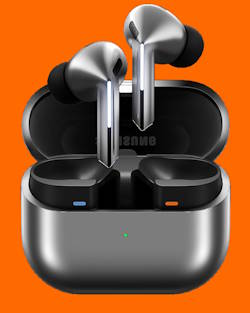
Samsung finally revealed the latest Galaxy Buds, Galaxy Buds 3 and Galaxy Buds 3 Pro, on July 10, 2024. The new radical design and the new features of Galaxy Buds 3 and Galaxy Buds 3 Pro have gained mixed receptions.
This Galaxy Buds guide explains the top 10 new features of Galaxy Buds 3 and Galaxy Buds 3 Pro: the new radical design, stem control, Interpreter, Super Wide Band call, 24-bit/96kHz Samsung Seamless Codec, voice command, LE audio (Auracast)support, adaptive ANC, adaptive EQ, and the IP 57 rating.
These features are available on both Galaxy Buds 3 and Galaxy Buds 3 Pro. The unique features of Galaxy Buds 3 Pro, and the differences between Galaxy Buds 3 and Galaxy Buds 3 Pro will be discussed in a separate post are discussed in this page.
Radically new (not necessarily better) design
Samsung has departed from the traditional pure in-ear design found in previous generations of Galaxy Buds (e.g., Galaxy Buds, Galaxy Buds+, Galaxy Buds Pro, Galaxy Buds Live, Galaxy Buds 2, and Galaxy Buds 2 Pro. The Galaxy Buds 3 and Galaxy Buds 3 Pro now feature a new stemmed design, resembling the design of Apple's AirPods and AirPods Pro.
Moreover, Galaxy Buds 3 matches the open-ear design of Airpods without the ear tips. Galaxy Buds 3 Pro looks like a clone of AirPods Pro, especially for the white model.
Both in-ear and stemmed designs have advantages and disadvantages. So, some will welcome this new design, and some will surely not.
Stem control: one of the most useful new features of Galaxy Buds 3 and Galaxy Buds 3 Pro
One drawback of in-ear wireless earbuds is the touch control. Due to the small sensor area, it is hard for many users to control the earbuds easily. Often, frustrated owners have to pull out their smartphones to control or adjust the earbuds, e.g., with the widget.
The design with the stem provides convenient controls for the earbuds. Apple, like it or not, has demonstrated the ease of controlling wireless earbuds using the force sensor on the stem.
Samsung copied and tweaked these stem controls in Galaxy Buds 3 and Galaxy Buds 3 Pro. You can control the buds with the swipe and the pinch gestures.
For Galaxy Buds 3 Pro, Samsung also added a cool (and maybe disturbing) feature: you can choose to light up the stem (Blade Light).
Interpreter
Galaxy S24 already demonstrated the real-time translation feature using Galaxy AI. Now, you can speak and listen with the Galaxy Buds 3 or Galaxy Buds 3 Pro.
Please note that Galaxy Buds 3 and Galaxy Buds 3 Pro are not capable of doing real-time translation by themselves. So, the translation ( Interpreter) is available only when wearing Buds and connected to a Samsung Galaxy smartphone with Android 14 (One UI 6.1) or later.
We noticed some wrong information about Super Wide Band (Bluetooth). First, it is not a Bluetooth codec. Super Wide Band (SWB) is an optional part of the latest Hands-Free Profile (HFP) v1.9. It is for phone calls, not music. However, SWB is linked to Bluetooth LE Audio because it uses the LC3 codec.
Please do not confuse Super Wide Band with Ultra-Wideband (UWB). They are two totally different things.
In a nutshell, Super Wide Band (SWB) support allows the devices to expand the range of frequencies reproduced. The result is clearer and more natural human voices for phone calls through Bluetooth devices.
Traditionally, HD voice means the sound is sampled at up to 16kHz, which corresponds to the Wide Band. The Super Wide Band (SWB) requires a sample rate of up to 32kHz.
Both Galaxy Buds 3 and Galaxy Buds 3 Pro support the Super Wide Band (SWB) call. There are only a few wireless earbuds in the market that support SWB, e.g., Pixel Buds Pro.
24-bit/96kHz Samsung Seamless Codec
Samsung touted its proprietary Samsung Seamless Codec (SSC) as a HiFi codec on Galaxy devices.
The Galaxy Buds 2 Pro is compatible with the Samsung Seamless Codec, supporting audio quality of up to 24-bit/48kHz. Samsung has elevated its standards with the introduction of the Galaxy Buds 3 and Galaxy Buds 3 Pro, both of which are equipped to support the Ultra High-Quality Samsung Seamless Codec at up to 24-bit/96kHz.
In reality, the Bluetooth audio quality highly depends on the connection quality and audio source. Bluetooth codec is only part of the game. Compared to Galaxy Buds 3, Galaxy Buds 3 Pro apparently has slightly better sound quality.
Please note that the 24-bit/96kHz Samsung Seamless Codec (SSC Ultra High-Quality) is currently only supported on Samsung Galaxy devices with One UI 6.1.1 or later, such as Galaxy S24, Galaxy Fold 6, and Galaxy Flip 6.
Voice Command
You can control Galaxy Buds 3 and Galaxy Buds 3 Pro with voice commands without needing to touch the controls.
Moreover, you do not need to use hotwords to wake up the voice command feature.
![SAMSUNG Galaxy Buds 3 AI True Wireless Bluetooth Earbuds, Open Type Fit, Active Noise Cancellation, 360 Audio, Touch Control, Silver [US Version, Amazon Exclusive, 2Yr Warranty]](https://m.media-amazon.com/images/I/317mIBCIEyL._SL160_.jpg)
![Samsung Galaxy Buds 3 Pro AI True Wireless Bluetooth Earbuds, Noise Cancelling, Sound Optimization, Redesigned Comfort Fit, Silver [US Version, Amazon Exclusive, 2Yr Warranty]](https://m.media-amazon.com/images/I/41lJzPsRHjL._SL160_.jpg)
Blutooth LE Audio (Auracast) support: one of the most future-proof new features of Galaxy Buds 3 and Galaxy Buds 3 Pro
Auracast is an advanced broadcast audio technology that enables simultaneous audio sharing across multiple Bluetooth devices. This versatile feature, which is part of Bluetooth LE Audio, has wide-ranging applications, from facilitating shared music experiences among individuals to public audio broadcasting in spaces like airports, bars, and gyms.
Both Galaxy Buds 3 and 3 Pro support Auracast, but Galaxy Buds 2 Pro requires a firmware update to do so. Sony WH-1000XM6 also supports Auracast.
Please note that Samsung is silent on the support of the LC3 codec on the Galaxy Buds 3 and Galaxy Buds 3 Pro. You can assume that the LC3 codec (for music) is NOT supported by these devices.
Adaptive EQ
The Galaxy Buds 3 and Galaxy Buds 3 Pro leverage Galaxy AI to dynamically adjust the Active Noise Cancellation (ANC) and audio equalizer based on environmental conditions.
Samsung named this new feature as adaptive EQ.
When playing music, it is not necessary for you to manually switch between various equalizer presets. Galaxy Buds 3 and Galaxy Buds 3 Pro can autonomously tailor the equalizer settings to correspond with the genre of music being played.
Adaptive ANC
Both Galaxy Buds 3 and Galaxy Buds 3 Pro have the active noise canceling (ANC) feature, although Galaxy Buds 3 adopts the open-ear design.
Both also support the so-called Adaptive ANC feature, which essentially adjusts the strengths of active noise cancellation and audio passthrough based on ambient sounds. This new feature is similar to the adaptive transparency mode or adaptive mode on AirPods Pro 2.
For example, if there is a siren or a person speaking directly in front of you, the Galaxy Buds 3 or Galaxy Buds 3 Pro reduces the ANC and allows outside audio to pass through to your ears, letting you stay aware of important things around you.
IP57 rating
Both Galaxy Buds 3 and Galaxy Buds 3 Pro have an IP57 rating for dust and water resistance, an improvement over the Galaxy Buds 2 Pro's IPX7 rating.
Do you have any questions about the new features of Galaxy Buds 3 and Galaxy Buds 3 Pro?
Please let us know in the comment box below if you have any questions about the new features of Galaxy Buds 3 and Galaxy Buds 3 Pro or need help on these two devices.
You may check Headphone 101 for detailed explanations of headphone technologies and terms.
For Bluetooth headphone guides, please check the Bluetooth headphones section.
The sports headphones section is dedicated to guides on sports headphones.
You may also reach us through our Facebook page.


Leave a Reply